
.338 Lapua Magnum punishes hardware. The bore that makes a .30-caliber can useful across most of a safe is simply too small to let a .338 projectile through, so the cartridge forces a separate purchase rather than an adapter or a spacer. That narrows the market sharply, and what is left in it is stranger than most buyers expect.
What the .338 Lapua market actually looks like today
The block above is every .338-rated can we can currently see, drawn from 42 live listings across 12 retailers. That is a thin market by the standards of this site — the 9mm and rimfire categories carry several times the listing count — and thin markets price strangely. The spread between where the category starts and where it tops out is wide enough that two cans doing nominally the same job can sit at opposite ends of it.
Thunder Beast carries the most listings of any brand in the bucket, and its entry point sits well above the category floor. SilencerCo, Rugged, Savage and Anechoic fill the middle. Dead Air appears only twice. A category this small means the number you see is driven by which two or three retailers happen to have stock, which is exactly why a static price written into an article a year ago would be worthless now.
Why the entry price is not the cheapest listing anywhere
The figure in the block above is the third-cheapest listing we can see, not the single lowest. That is deliberate, and in a category this thin it matters more than usual.
In a catalog of this size the outright cheapest listing for any given can is very often wrong. It is a discontinued configuration, a mislabelled variant, a retailer's placeholder record, or a price that will not survive contact with the checkout page. Quoting it would make the category look several hundred dollars cheaper than anyone can actually buy into it. Taking the third listing up gives a number that at least two other retailers agree is plausible, which is a far better description of where the category genuinely starts.
The practical consequence for a buyer is simple. If you find a .338-rated can listed well below the entry price in that block, treat it as a question rather than a bargain. Check that the caliber rating belongs to that model and not to a larger can in the same family, and check that the configuration is current.
Why most cans sold as ".338 Lapua" are really modular cans
Read the product names in the table below and a pattern shows up quickly. A large share of what gets listed under .338 Lapua is not a dedicated magnum can at all. It is a modular multi-caliber design — 9mm through .338, or 5.7x28 through .338 — whose top-end rating happens to be this cartridge. The Omega 36M, the Hybrid 46M, the Alaskan360 and the Anechoic X35 all reach .338 Lapua as the upper bound of a range that starts at a pistol caliber.
That is not a complaint. It reflects how the market is built: a manufacturer that has engineered a tube strong enough for .338 Lapua has, almost by definition, built something that handles everything below it, and there is more money in selling that breadth than in selling a single-purpose magnum can. Our guide to multi-caliber suppressors covers what that label does and does not promise, because "rated to .338" and "good on .338" are different claims.
The genuinely dedicated .338 designs — the Savage AccuCan AC338, the Barrett AML338, the Thunder Beast magnum cans — are a minority of the listings and sit differently on price. They are also, generally, longer and heavier, because that is what a magnum bore asks for.
It is worth knowing which kind you are looking at before you compare two numbers. A modular can and a dedicated magnum can at the same price are not competing on the same terms: one is buying you breadth across several hosts, the other is buying you a can optimised for one cartridge. Neither is better in the abstract.
Does a .30-caliber can cover .338 Lapua?
It does not, and this is the single most expensive mistake available in this category. A .30-caliber suppressor is bored for a .308 projectile. A .338 bullet does not fit. The result is a baffle strike that ruins the can and can take the rifle's crown with it.
This matters because the .30-caliber can is the one most enthusiasts already own. If you are working out how far a single can stretches across the safe, our .30 caliber suppressor guide is the right starting point — it covers .308, 7.62x51 and the cartridges that share that bore. The 6.5 Creedmoor guide makes the same argument from the other direction, since that cartridge is comfortably inside .30-caliber bore limits and does not need a dedicated can at all. .338 Lapua is the point where that logic stops working.
The cans worth the paperwork

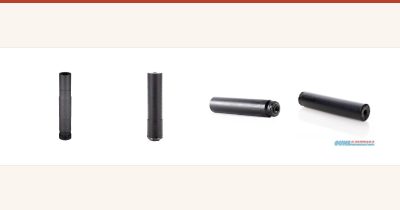
Modular stainless and titanium, listed from 5.7x28 through .338 Lapua Magnum

Purpose-built .338 Lapua Magnum can on a 5/8x24 thread

Multi-caliber tube listed from 9mm through .338 Lapua, in steel and titanium versions

Modular design listed from 9mm through .338 Lapua Magnum
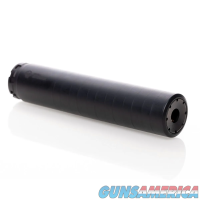
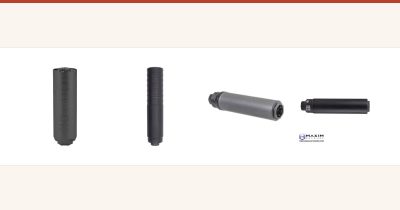
Direct-thread stainless can listed from .458 down through .338 Lapua

Titanium flow-through can listed for 9mm, .308, 5.56 and .338 Lapua

Dedicated .338 magnum can from a maker that also builds the rifles
Direct thread or quick detach on a magnum rifle?
The listings in this category split roughly into two mounting philosophies, and the choice has more consequence on .338 Lapua than it does further down the caliber range.
Direct thread is simpler, lighter and cheaper, and it puts nothing between the barrel shoulder and the can. Several of the cans above are listed as direct-thread models on a 5/8x24 pattern. The cost is that the can has to come off by hand, and magnum recoil is unusually good at working a threaded joint loose over a string of fire.
Quick-detach and taper-lock systems add a muzzle device, some weight and some price, and in exchange the can indexes to the same place every time and comes off without unscrewing. On a rifle that is shot suppressed and unsuppressed in the same session, or a can that moves between hosts, that repeatability is most of the argument. Manufacturers publish return-to-zero specifications for these systems; those are manufacturer figures rather than anything measured here, and they assume the mount is installed correctly and torqued to spec.
A dedicated magnum can, or one can for the whole safe?
The honest answer depends on how many rifles the can has to serve.
If the .338 is a dedicated long-range rifle that lives in its own case and gets shot deliberately, a dedicated magnum can is the better buy. It is built for the pressure and the heat, the length is tolerable on a rifle that is already long and heavy, and you are not carrying modular hardware you never reconfigure. The trade-off is that it does exactly one job, and a Form 4 is a slow way to buy a single-purpose tool.
If the .338 is one rifle among several, a modular can rated to .338 is the more sensible registration. One tube covers the magnum, the .308, and in several of these designs a 9mm host as well. The trade-off is real, though, and worth saying plainly: a can engineered to survive .338 Lapua is overbuilt for a 9mm carbine. You carry that weight and length on every host, and a dedicated 9mm suppressor will be shorter, lighter and quieter on a pistol-caliber gun than a magnum can running at the bottom of its range.
There is a second-order cost too. One can shared across four rifles means re-zeroing every time it moves, and it means the can is unavailable whenever it is mounted to something else. For a shooter who hunts with one rifle and competes with another in the same season, that is a scheduling problem rather than a theoretical one.
What the transfer adds before you take it home
Every can here is a Title II item under the National Firearms Act. The listed price is not the whole story: federally, a transfer runs through an ATF Form 4 with fingerprints, photographs and a background check, and the can stays with the dealer until it is approved.
The 2025 federal tax law zeroed the transfer tax on silencers effective at the start of this year, which removed the flat federal charge that used to sit on top of every can regardless of what it cost. None of the registration went away with it. Confirm the current fee schedule with your dealer, because the implementation details are still settling. Approval times move as well, and no honest article states a current wait — ask the dealer handling your transfer what they are actually seeing.
Jurisdiction is the part that catches people. Suppressors are lawful under federal law across most of the country, but several states bar civilian ownership entirely and others allow ownership while restricting suppressor use for hunting. Those rules change, and they are the controlling authority regardless of what federal law permits. Verify your own state before you commit to a purchase.
Keeping a magnum can serviceable
.338 Lapua generates heat fast, and a can that is run hard will show it. Two practical notes. First, mount system matters more here than on a .308 — a direct-thread can on a magnum rifle wants checking between strings, because recoil that severe can work threads loose. Second, heat management is a genuine consideration rather than an accessory upsell, and a suppressor cover protects the shooter and the rifle's handguard more than it protects the can itself.
Both dedicated and modular cans in this category are built from stainless, titanium or Inconel depending on model and price point, and those materials behave differently under sustained magnum fire. The listings specify the material, and it is worth reading before choosing between two cans that look equivalent on a spec sheet. Titanium saves weight on a rifle that is already heavy; stainless and Inconel are the usual answer where sustained heat is the governing concern.
Frequently asked questions
Will a .30-caliber suppressor work on a .338 Lapua?
No. A .30-caliber can is bored for a .308 projectile, and a .338 bullet will not clear it. Mounting one on a .338 Lapua rifle risks a baffle strike that destroys the suppressor and can damage the rifle. The caliber rating on a can is a bore limit, not a suggestion.
Do I need a dedicated .338 Lapua can, or is a modular one enough?
Both work if the can is rated for the cartridge. A dedicated .338 design is usually built heavier and longer, which is what a magnum bore asks for. A modular can rated up to .338 buys you the ability to run the same tube on smaller hosts, at the cost of length and weight you carry on every rifle.
What thread pitch do .338 Lapua suppressors use?
Most of the .338-rated cans in our catalog are listed with a 5/8x24 thread, which is the common pattern on .30-caliber and magnum rifle barrels. Some models mount through a proprietary quick-detach brake instead. Check the listing for your specific model rather than assuming.
Does a suppressor shift point of impact on a .338 Lapua?
Expect a shift when the can goes on and again when it comes off. Manufacturers publish repeatability figures for their mounting systems, and quick-detach designs are generally specified to return closer to zero than a can that is threaded on by hand. Confirm your own zero suppressed before you rely on it.
How does the transfer process work?
A suppressor is a Title II item under the National Firearms Act. Federally that means an ATF Form 4 transfer, fingerprints, photographs and a background check before the can leaves the dealer. The 2025 federal tax law zeroed the transfer tax on silencers effective at the start of this year, but none of the registration was repealed. Confirm the current fee schedule with your dealer, because the implementation details are still settling.
Is a .338 Lapua suppressor legal where I live?
Suppressors are legal under federal law in most of the country, but several states prohibit civilian ownership outright and others restrict how they may be used for hunting. State law is the controlling question here, and it changes. Verify your own state and your specific hunting regulations before you file.
Guns & Gear HQ earns a commission when you buy through links on this page. It costs you nothing and it is what pays for the price tracking behind these numbers. We pick products on the merits and quote whatever the retailers actually charge.

Comments