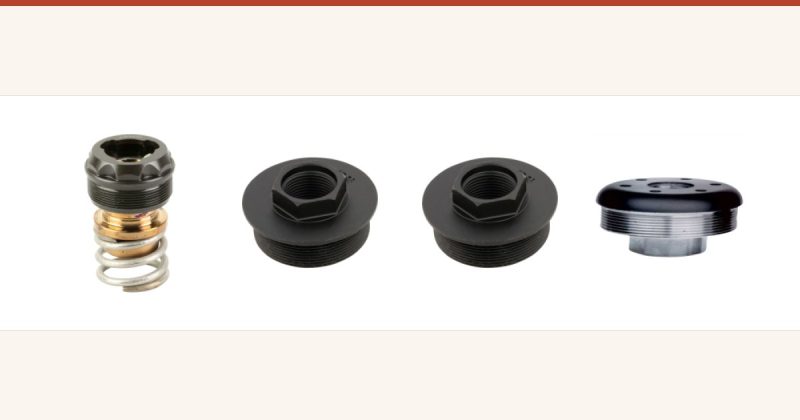
The mount is the cheapest part of a suppressor setup and the one you are least able to change your mind about. The can gets picked over weeks of reading. The mount gets picked in a checkout flow, and then it quietly dictates every muzzle device you buy for the next five years.
That block spans the whole accessory category, covers included, so treat it as the shelf rather than the shelf you are shopping. Narrowing to mounting hardware alone, the listings in this assignment sort into three tight bands, and the gaps between them are the actual decision.
Direct thread is the default, and it is not the compromise
Screw the can onto the barrel. No intermediate device, no extra parts, nothing ahead of the muzzle that was not already there.
In the data we pulled for this piece, rear thread and fixed mounts run from about fifty-three dollars at the third-cheapest listing up to the low seventies, in pitches like 3/4x24, 9/16x24, .578x28, 11/16x24 and M18x1. That is the whole cost. There is no second purchase.
The case for it is real. Fewer interfaces means fewer things to come loose or index imperfectly, it adds no length ahead of the muzzle, and it is the cheapest way to get a can onto a rifle. Plenty of precision shooters run direct thread on purpose, not because they could not afford the alternative.
The trade-off is time and heat. Taking a hot can off a threaded barrel is a slow job and a burned-fingers job, which is one more reason to be running a cover if you swap often. Direct thread cans can also walk loose over a long string, so checking tightness between strings becomes a habit. And moving the can between hosts means matching thread pitch on every barrel, which is the constraint people forget until they buy a rifle with a different pitch.
Quick detach costs about fifty dollars per host, forever
This is the number that matters and the one nobody puts in a headline. A quick-detach system is two halves: the rear mount on the can, and a muzzle device on every single rifle you want to run it on.
Three-lug mounts in this assignment cluster hard at a hundred and five dollars, with one at a hundred and eighteen, against direct thread hardware in the fifties and sixties. So the rear mount itself is roughly double. Then every host needs its own muzzle device on top of that, in the correct thread pitch, and that per-rifle cost repeats for as long as you keep adding hosts.
What you buy with it is speed and repeatability. The can goes on and comes off in seconds without touching hot threads, and it indexes to the same place each time. If you own one can and four rifles and you actually move it between them, quick detach pays for itself in convenience long before it pays for itself in anything else. If you own one can and one rifle, you are buying a solution to a problem you do not have.
The muzzle device is a decision, not a fitting
Here is where people get surprised. On most quick-detach systems the muzzle device is a brake, and a brake is loud to the sides. You will notice it unsuppressed, and anyone standing next to you will notice it more.
The alternatives exist. Several systems offer the mounting interface as a flash hider or a plain adapter instead of a brake, and flush-fitting mounts add almost nothing ahead of the muzzle. In this assignment the flush mounts sit at seventy-five dollars, between the direct-thread band and the three-lug band, which is a reasonable read of what they are: a middle option.
Decide whether the host ever gets shot without the can. If it does, the muzzle device is a permanent part of that rifle's character, and picking a brake because it came with the mount is how you end up with a range gun nobody wants to stand beside.
Expect the can to move your point of impact
Hanging a suppressor off a muzzle changes where the rifle shoots, and the mount is part of that. Adding mass and length ahead of the muzzle alters barrel harmonics, and the shift is usually consistent for a given can on a given host rather than random.
The practical consequence is that suppressed and unsuppressed are two different zeroes on the same rifle, and you need to know the offset for yours. Confirm it on paper rather than assuming, because the size and direction vary by rifle, barrel profile and mount.
This is also the strongest argument for a repeatable mounting interface. If the can indexes to the same position every time, the offset stays the same and you can hold for it. If the interface is sloppy, or a direct-thread can is torqued a little differently each time, the offset moves and you are chasing it. That consistency, more than raw convenience, is why quick-detach systems earn their place on rifles that get shot both ways.
Installation is where good hardware gets ruined
The mounting device has to be square to the bore, and that is a job worth doing carefully or paying somebody to do. A muzzle device that is not seated against a properly cut shoulder can sit at a slight angle, and a can threaded onto it inherits that error — which at worst is a baffle strike and a destroyed suppressor.
Timed devices need to be indexed, which means shims or a crush washer, and the temptation to overtighten until the ports line up is how threads get stretched. If the barrel shoulder was never faced square, no amount of torque fixes it.
None of this is exotic, but it is the difference between hardware that works for years and an expensive lesson. If you are not confident the shoulder is square, that is a gunsmith conversation before it is a purchase.
HUB is the hedge against picking wrong
The 1.375x24 rear thread, generally called HUB, shows up throughout this category, including on thread adapters sold specifically to convert HUB-pattern cans and on quick-detach hardware built to that standard.
The point of it is that the mount stops being permanent. A can with a HUB rear thread can wear direct thread hardware today and a quick-detach system in two years without replacing the suppressor. If you genuinely do not know yet how you will use the can, this is the answer, and it is worth prioritising a HUB-compatible can over a marginally quieter one that locks the mount.
It also matters for anyone running a multi-caliber can across a mixed safe. One can, several hosts, several thread pitches, and a rear interface you can reconfigure is a far more flexible position than a fixed mount chosen on the day you ordered.
Three-lug is a pistol-caliber answer
Three-lug is the standard on subguns and pistol-caliber carbines, and the price data reflects a mature product category rather than a niche one, with a cluster of listings from several retailers all landing at the same figure.
It mounts and dismounts faster than anything else, it takes abuse, and on a 9mm host it is the arrangement most people end up at. The trade-off is that three-lug is a pistol-caliber convention. It does not carry over to a rifle, so a three-lug mount is a commitment to that side of the safe specifically.
On a slow-fire pistol the calculus is softer. A direct thread can with a booster does the same job, and the speed advantage matters less when you are not dropping the can between drills.
What actually belongs on your setup
One can, one rifle, and it mostly stays together: direct thread. Buy the cheapest correct thread pitch and spend the difference on ammunition.
One can, several rifles, moved often: quick detach, and budget the muzzle devices up front rather than discovering them one at a time. A 5.56 carbine and a bolt gun in a different pitch are two purchases, not one.
A precision rifle that never gives the can up: direct thread, or a flush mount if you want the option without the length.
A pistol-caliber host: three-lug, unless it is a slow-fire pistol.
Undecided: buy a can with a HUB rear thread and decide later. That is the whole reason the standard exists.
The part that is regulated, and the part that is not
Mounts, adapters and muzzle devices are unregulated hardware and ship to your door. The suppressor is the item that requires a federal transfer, and the Form 4 process is the long wait in the project. Ordering the mounting hardware while the can is in transfer is sensible, provided you have settled on a system.
One caution worth repeating: a muzzle device permanently attached to a short barrel is how people bring a rifle to legal length, and that is an area where the federal rule and your state's rule can differ. If barrel length is part of your plan, verify the current requirements for your own jurisdiction rather than treating a forum answer as settled. The mount itself is not the regulated part; what it is bolted to can be.
Frequently asked questions
Is a direct thread mount less accurate than quick detach?
No. Direct thread puts the can on the barrel with the fewest parts in between, which is why a lot of precision shooters stay with it. Repeatability problems come from a loose interface or a shoulder that is not square, not from the mounting style itself.
What is a HUB mount and why does it matter?
HUB is a shared 1.375x24 rear thread that a number of makers build to, so one can accept mounting hardware from several sources. It matters because it turns the mount into a swappable part rather than something you are locked into for the life of the suppressor.
Do I need a muzzle device for every rifle?
With a quick-detach system, yes. The muzzle device is the other half of the mount, so every host you want to run the can on needs one in the correct thread pitch. That per-host cost is the part most buyers underestimate.
Can a suppressor mount come loose while shooting?
Direct thread cans can walk loose over a long string, which is why people check them between strings or use a rear-thread mount with a positive lock. Quick-detach systems are designed to resist it, but they still need the muzzle device itself torqued properly to the barrel.
Is three-lug worth it on a pistol-caliber host?
On a subgun or a pistol-caliber carbine it is the standard for good reason, because it mounts and dismounts fast and handles the abuse. On a slow-fire pistol it is mostly convenience, and a direct thread can with a booster does the same job for less.
Does the mount change how loud the suppressor is?
Not meaningfully on its own, though a muzzle brake used as a mounting device is louder to the sides than a plain thread adapter or a flash hider. If side blast matters where you shoot, that is an argument for a non-brake mounting device.
Guns & Gear HQ earns a commission when you buy through links on this page. It costs you nothing and it is what pays for the price tracking behind these numbers. We pick products on the merits and quote whatever the retailers actually charge.

Comments