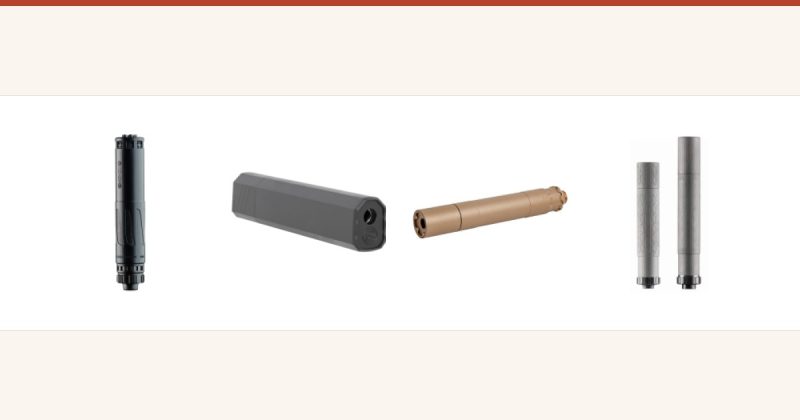
Nobody builds many 10mm suppressors, and the reason is not that the cartridge is unpopular. It is that suppressor manufacturers build to bore diameter, and 10mm shares its .400-inch projectile with .40 S&W and sits comfortably under the .451-inch bore of a .45 can. A company that has tooled up for .45 ACP has already solved 10mm. There is very little commercial reason to produce a tube with 10mm stamped on it.
That makes this one of the strangest categories we track, and one of the few where the honest answer to "what should I buy" is a product with a different number on the side.
What the 10mm market actually looks like today
The block above covers every can we can currently see listed for 10mm, and it is a thin slice by any standard — single figures of listings, across a handful of retailers. Compare that to the 9mm or rimfire buckets, which carry listing counts an order of magnitude larger, and the shape of the problem is obvious.
Thin markets behave badly. The median and the top of the range in that block are the same number, which is not a rounding artifact: most of the listings we can see are the same can at a small number of retailers, so there is no real distribution to speak of. A single retailer restocking or dropping a product moves the whole category. That is precisely why a price typed into an article a year ago would be useless today, and why the figure above is generated fresh every time this page loads.
Why the entry price is not the cheapest listing anywhere
The entry figure in that block is the third-cheapest listing we can see rather than the single lowest, and in a bucket this small the reason is unusually easy to demonstrate.
The cheapest row in the table below is a used Gemtech Raptor. Our catalog records what retailers publish, and retailers do not consistently flag second-hand inventory in a way a price feed can read, so a used can sits in the same aggregate as new stock. Quoting that as the market floor would tell you the category starts several hundred dollars below where anyone can actually buy a new can. Stepping up to the third listing gives a number at least two other retailers agree is plausible.
The practical version of that advice: if you find a 10mm-rated can listed well under the entry price, read the listing properly before you get excited. Check whether it is used, whether the caliber rating belongs to that model or to a larger can in the same family, and whether the configuration is still current.
The bore is the specification that matters
Suppressors are rated by the largest projectile they will pass, and everything else on the spec sheet is secondary to that one number.
A 10mm Auto bullet measures about .400 inch, the same as .40 S&W. A .45 ACP can is bored for roughly .451 inch. The 10mm projectile therefore clears a .45 bore with a comfortable margin, which is why so much of what serves this caliber was designed and sold as .45 hardware. Our guide to .45 ACP suppressors is the companion piece here, because for a large share of 10mm buyers the correct purchase is sitting in that category.
The trade-off is real and worth stating plainly: bore clearance costs suppression. A can whose baffles are cut for a .451-inch projectile is not sealing as tightly around a .400-inch bullet as a can bored for .400 would. You are buying breadth and paying for it in performance, and the manufacturers who publish sound figures publish them per host and per cartridge for exactly this reason. Those are manufacturer specifications rather than anything measured here.
It does not work in the other direction. A 9mm can is bored for a .355-inch projectile and will not pass a 10mm bullet. That is the single most expensive mistake available in this category, and it ends with a baffle strike, a destroyed can and a Form 4 you get to file again.
The cans worth the stamp
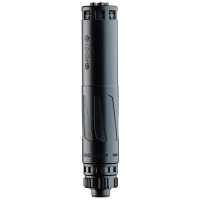
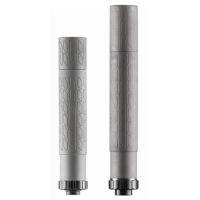
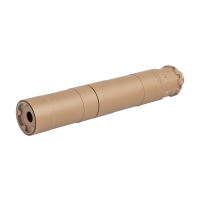
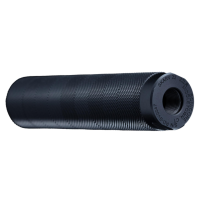
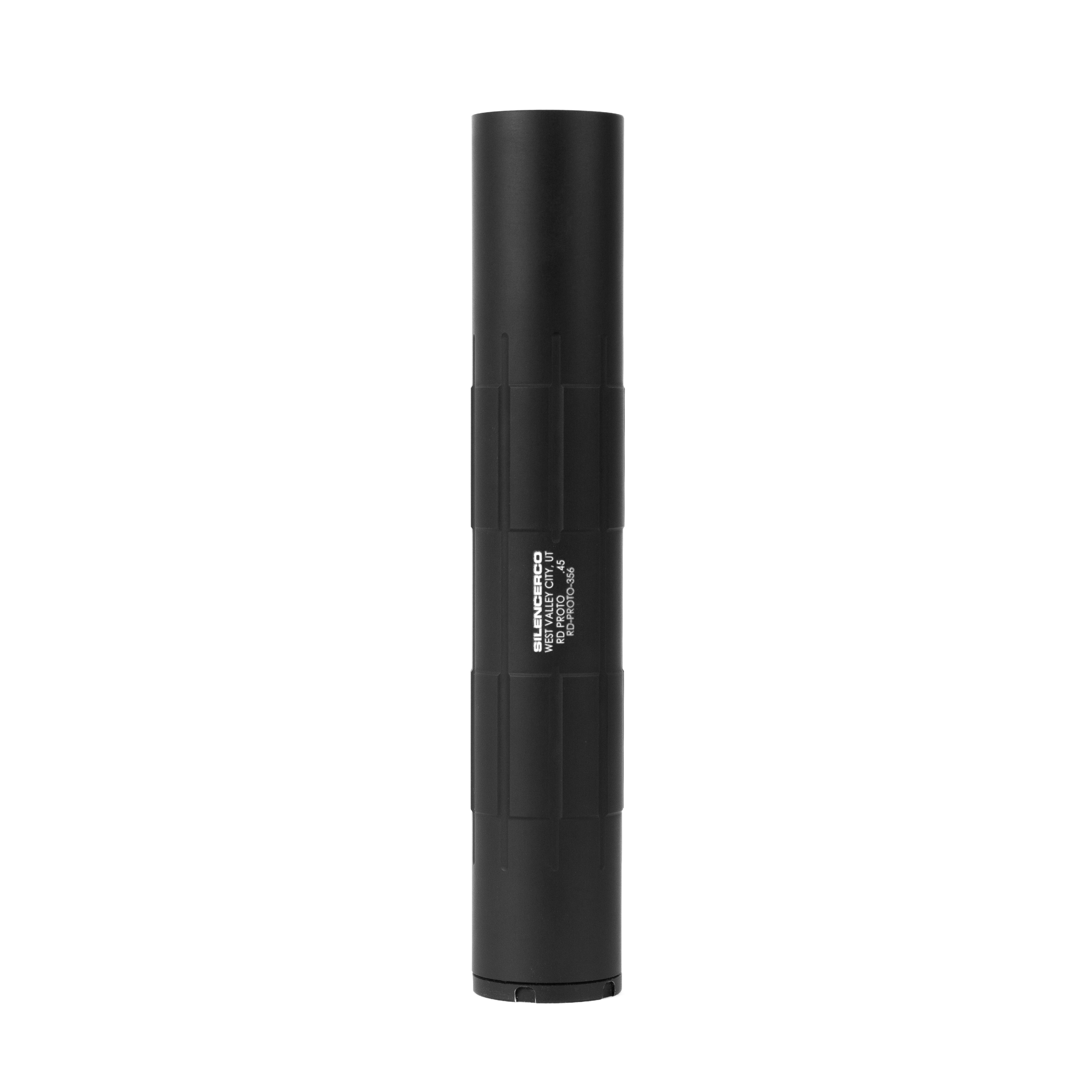
Titanium direct-thread pistol can listed for 9mm and 10mm
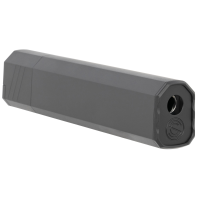
Eccentric pistol can listed from 9mm through .45 ACP
Modular .45-bore pistol can, user-configurable length
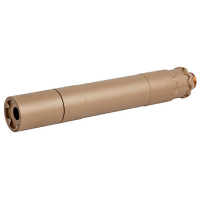
Two-configuration .45-bore can, user-serviceable baffle stack
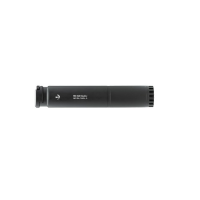
Short .40-bore can from a maker better known for submachine guns
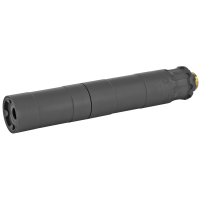
Quick-detach .45-bore can built around the APC45 platform
Dedicated 10mm or a .45 can that covers it?
Both are defensible, and the deciding factor is how many hosts the can has to serve.
A can listed specifically for 10mm — the Dead Air RXD910Ti is the clearest example in our catalog, and the only one we see stocked by more than one retailer — is bored closer to the projectile and built around the pressure the cartridge actually generates. If the 10mm is the gun you bought the can for, that tighter bore is the better engineering answer.
A .45-bore can buys coverage instead. One registration covers 10mm, .40 S&W, .45 ACP and, on most designs, 9mm underneath them. For a shooter with a mixed pistol safe, that breadth is worth more than the suppression given up to bore clearance, and it is a far more efficient use of a transfer that takes months to clear. Our guide to multi-caliber suppressors covers what that label promises and where it stops, because "rated for" and "optimised for" are different claims and the marketing rarely distinguishes them.
There is a second-order cost to the one-can approach that buyers routinely underestimate. A can shared across four pistols is unavailable whenever it is mounted to one of them, and it needs re-checking each time it moves. That is a scheduling problem rather than a theoretical one.
Direct thread or quick detach on a 10mm host
The mounting question splits along host type more than along preference.
A tilting-barrel pistol — a Glock 20 being the obvious 10mm example — generally needs a booster, also called a Nielsen device or linear inertial decoupler. The mass of a can hanging off the barrel interferes with the unlocking cycle, and the booster restores enough impulse for the pistol to run. Several of the cans above ship configured for this; several sell the piston separately, and the correct piston is thread-pitch specific. Read the listing rather than assuming.
A fixed-barrel host does not need any of that. A 10mm carbine or a fixed-barrel pistol takes a direct thread mount, which is simpler, lighter and cheaper, and puts nothing between the shoulder and the can. The cost is that it comes off by hand and wants checking between strings.
Quick-detach systems add a muzzle device, some weight and some price, and return the can to the same index every time. On a can that moves between hosts — which, in this category, is most of them — that repeatability is most of the argument.
Heat, and what a 10mm carbine does to a pistol can
10mm out of a carbine is a different thermal problem than 10mm out of a Glock, and pistol-caliber cans are not all rated for sustained fire.
The material and the rating are published per model. Stainless and Inconel stacks tolerate sustained heat that will shorten the life of an aluminium one, and several of the cans here are offered in more than one material at different weights and prices. Check the manufacturer's rate-of-fire rating against how you actually intend to shoot rather than against how the can is photographed.
If the can spends time on a carbine, a suppressor cover is worth budgeting for. It does less for the can than buyers assume and rather more for the handguard, the optic sitting above it and the hands nearby, and it kills the mirage that makes a hot can miserable to shoot behind.
What the transfer adds before you take it home
Every can on this page is a Title II item under the National Firearms Act, and the listed price is not the whole transaction. Federally, the purchase runs through an ATF Form 4 with fingerprints, photographs and a background check, and the can stays with the dealer until the transfer is approved.
The 2025 federal tax law zeroed the transfer tax on silencers effective at the start of this year, which removed the flat federal charge that used to sit on top of every can regardless of price. None of the registration requirements went away with it. Confirm the current fee schedule with the dealer handling your transfer, because the implementation details are still settling, and ask them what approval times they are actually seeing rather than trusting any published figure. Our walkthrough of the Form 4 process covers the paperwork end to end.
Jurisdiction is the part that catches buyers out. Suppressors are lawful under federal law across most of the country, but several states bar civilian ownership entirely and others allow ownership while restricting suppressor use for hunting. Those rules are the controlling authority regardless of federal permission, and they change. Verify your own state before you commit money to a can.
Frequently asked questions
Can I use a .45 ACP suppressor on a 10mm?
Yes, and for most buyers that is the practical answer. A .45-bore can is drilled for a .451-inch projectile, and a 10mm bullet measures about .400 inch, so it passes through with room to spare. You give up some suppression to that extra bore clearance. What you must not do is run it the other way around and put a .45 projectile through a bore cut for something smaller.
Will a 9mm suppressor work on 10mm?
No. A 9mm can is bored for a .355-inch projectile and a 10mm bullet is roughly .400 inch. The bullet does not fit, and the result is a baffle strike that destroys the suppressor. The bore rating on a can is a hard limit rather than a guideline, and 9mm and 10mm are not interchangeable despite both being named in millimetres.
Is a .40 S&W suppressor the same as a 10mm suppressor?
For bore purposes, effectively yes. The .40 S&W and 10mm Auto share the same .400-inch projectile diameter, which is why several of the cans listed for this caliber carry a 40 in the model name. The difference between the two cartridges is case length and pressure, which matters to the host firearm and to the booster on a tilting-barrel pistol, not to the hole through the baffle stack.
Does a 10mm pistol need a booster to cycle suppressed?
A tilting-barrel pistol such as a Glock 20 generally does, because the weight of the can hanging off the barrel interferes with the unlocking cycle. That part is a Nielsen device, sold as a booster or a linear inertial decoupler. A fixed-barrel host such as a 10mm carbine does not need one and usually takes a direct thread mount instead. Check which your can ships with, because it is often a separate purchase and the piston is thread-pitch specific.
Why are there so few 10mm suppressors for sale?
Because manufacturers build to bore diameter rather than to cartridge. A company that has tooled up for a .45-bore pistol can has already covered 10mm, .40 S&W and everything below it, so there is little commercial reason to produce and market a separate 10mm-only product. The cartridge is well served; it is just served by cans with other numbers on the tube.
Is a 10mm suppressor legal to own?
Suppressors are lawful under federal law in most of the country and are transferred as Title II items under the National Firearms Act. Several states prohibit civilian ownership outright and others permit ownership while restricting suppressor use for hunting. State law controls regardless of what federal law allows, and it changes. Verify your own state and your hunting regulations before you file anything.
Guns & Gear HQ earns a commission when you buy through links on this page. It costs you nothing and it is what pays for the price tracking behind these numbers. We pick products on the merits and quote whatever the retailers actually charge.

Comments