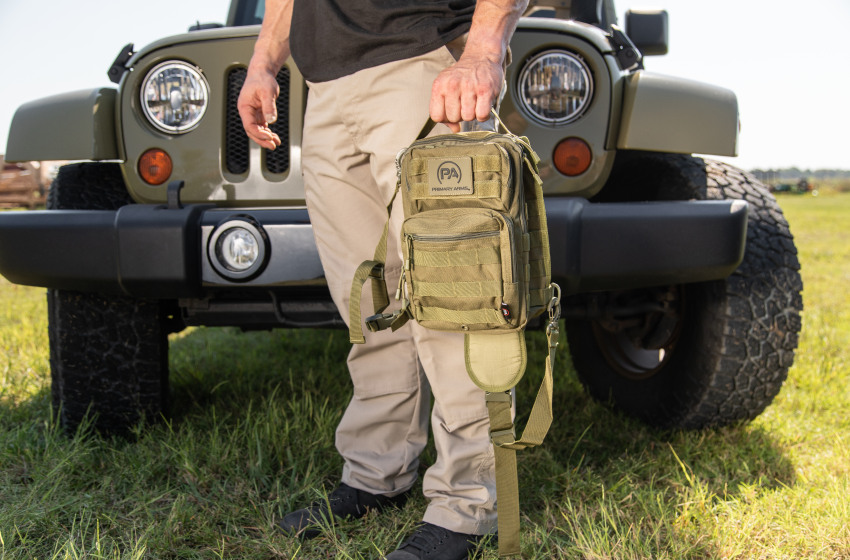
Carrying a concealed handgun while you drive raises a different set of problems than carrying on foot. You are belted into a seat, your draw stroke is partly blocked, and you may have to leave the gun behind when you walk into a place that does not allow it. There is no single right answer here. The best setup depends on you, your handgun, your vehicle, and the laws where you drive. In this article we walk through the trade-offs and the methods we actually recommend.
Choosing the Right Gun
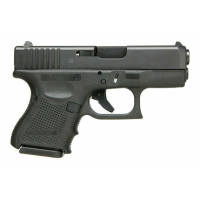
For most of us the answer is simple: the gun you already carry every day is the gun you should have in the car. There is no reason to downgrade reliability or function for a vehicle gun. Your everyday carry pistol is the one you have trained with and the one you will reach for under stress, so keeping that consistency matters more than owning a dedicated "car gun."
If you do plan to leave a firearm staged in the vehicle for long stretches, that is a different calculation. A gun left in a hot, cold, or theft-prone environment takes more abuse and more risk than one on your body, so some drivers reasonably choose a less expensive but still reliable handgun for that role. Just remember that a gun left in a vehicle is a gun that can be stolen, so plan storage accordingly.
Check the Law About Concealed Carry Inside a Vehicle
Before we get to methods, a disclaimer. We are not lawyers, and nothing here is legal advice. Carry and storage rules inside a vehicle vary widely from state to state, and they are some of the most inconsistent firearms laws in the country.
Permit reciprocity differs by state, so a permit that is valid where you live may not be honored where you are driving. States also disagree on the details: whether a handgun in the console or glovebox counts as concealed, whether it must be unloaded or cased, and what the rules are for parking lots and crossing jurisdictions. Some states treat a locked container very differently from a loose gun in the console.
Because of that, do not assume any of the practices below are legal where you are. Research the law in your state and any state you travel through, and consult a licensed attorney if you have questions. Everything that follows assumes you have confirmed it is legal for you.
Conceal Carry on Your Person
On-body carry remains the most accessible and best-retained option while driving, and for most people it is where we would start. The gun stays under your direct control, it goes with you when you step out of the vehicle, and there is no separate item to remember or secure.
The catch is that being seated and belted changes your access. A strong-side hip holster, inside or outside the waistband, is comfortable on a long drive because the gun rides away from your midsection, but the seatbelt typically lies across the grip. That makes drawing from a seated position slower and more awkward, which is why this position suits a full-size handgun or a situation where you expect to be out of the car before you would need the gun. It is close to how many police officers carry, since they plan to draw after exiting.
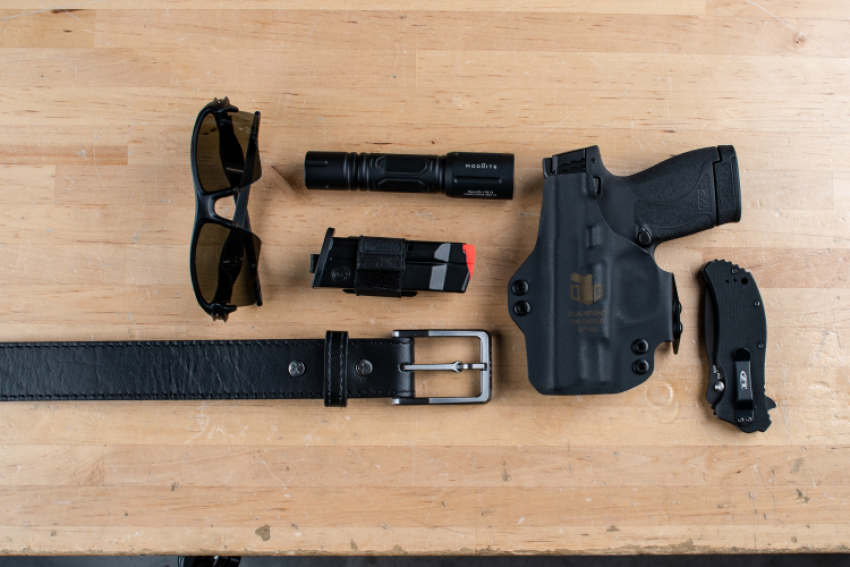
Appendix carry in an inside-the-waistband holster solves the seated-access problem. With the gun riding at the front of your waistband it ends up roughly in your lap when you sit, within easy reach of hands that are already near the wheel, and still fully under your control. For accessibility from the driver's seat, this is the strongest on-body choice.
The downside is comfort. Even slim shooters running compact guns can find that appendix carry jams the firearm into the stomach when seated, and on long trips it can become genuinely uncomfortable. It also works less well for larger-framed drivers, where a tight waistband leaves little room and adds more hard edges pressing in. For a short errand it is rarely an issue; for an all-day drive it can be.
Holsters Designed for Vehicles

A holster mounted in the vehicle is another way to keep a gun reachable from the seat. This can be done a couple of ways depending on your vehicle and how permanent you want the install to be.
A wedge-style or pocket holster fitted between the seat and the center console can give quick right-handed access without modifying the vehicle. More secure is a holster screwed to an interior panel or mount, which holds the gun firmly in place but means drilling into the vehicle, more than many drivers want to take on. For someone who spends most of the workday behind the wheel, a mounted holster can be a reasonable balance of access and control.
Whichever you choose, the same caution applies as everywhere else: confirm that storing a loaded handgun in the open this way is legal where you drive, and make sure the holster fully covers the trigger guard.
Loose in the Console or Glovebox
The simplest approach is to drop the handgun into the center console, the glovebox, or onto the seat under a cover. It is easy, and it may be what you do in a pinch, but we are cautious about it for two reasons.
First, the legal picture. Some states do not treat a gun in the console or glovebox as either concealed or secured, and a few restrict leaving a loaded handgun in a vehicle this way. This is exactly the kind of rule that varies by state, so check yours before relying on it.
Second, safety. A bare gun loose among other objects risks something working into the trigger guard. If we store a gun loose at all, we want it in a pocket holster or similar cover that protects the trigger, and generally only as a short-term measure when we have to enter a place where we cannot carry.
Gun Cases Designed for Vehicles
When you have to disarm and leave the gun in the vehicle, a locked vehicle vault or lockbox is the most secure option, and in some states a locked container is the only lawful way to leave a handgun in a car or truck. It is not the fastest way to access the gun, but with practice and the right product a quick-access vault can be reasonably quick.
Quick-access vaults earn their place either way. They cut down on the situations where a negligent discharge can happen, they keep the gun out of sight, and they protect it from theft when you have to leave it behind. Console, under-seat, and panel-mounted models are made specifically for vehicle use, bolting down out of view while still letting you get to the gun when you need it.
Conclusion
There is no single best way to carry in a vehicle. For the best balance of concealment and seated access, appendix inside-the-waistband carry is hard to beat. For comfort on long drives, a strong-side holster or an in-vehicle mount may suit you better, and when you have to step away from the gun, a locked vault is the safe and often the legal answer. Think it through before you need it, confirm your state's rules, and you will find a method that works for how you actually drive.
It is also worth carrying coverage that matches the responsibility. Look into concealed carry insurance so you are protected if you ever have to use your firearm.

Comments 1