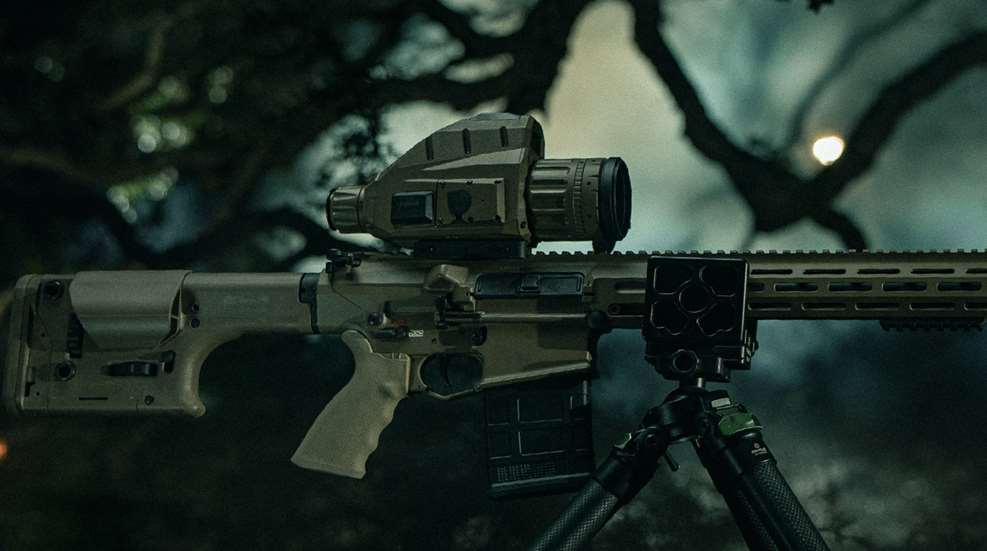
Trijicon released the REAP-IR-50 thermal riflescope series on October 2, putting the company's own sensor hardware at the center of a high-resolution thermal platform for the first time. Shooting Sports USA first covered the announcement. The scope is built around a 1024x768 uncooled vanadium oxide microbolometer developed by Trijicon's Electro Optics Division, a meaningful departure from the industry norm of sourcing sensor cores from third-party manufacturers.
50mm thermal riflescope, 1024x768 sensor, 1.5-12x magnification
The sensor runs at 50Hz with a 12-micron pixel pitch and a noise-equivalent differential temperature below 25 millikelvin — specs that place the REAP-IR-50 a full generation ahead of the 640x512 sensor arrays that define the top tier of current production hunting thermals. Paired with a 50mm f/1.0 manual-focus objective, the sensor displays through a 1280x1024 SXGA OLED panel. Magnification runs from 1.5x at base to 12x on continuous digital zoom.
Two variants are in the lineup. The standard REAP-IR-50 uses an onscreen stadiametric ranging system, overlaying reference markers on the display that allow shooters to estimate target distance by bracketing against a known height — no separate rangefinder required. The REAP-IR-50LRF adds a co-located laser rangefinder and an integrated ballistic solver. Trijicon measured the LRF variant at 0.72 inches taller and 3.5 ounces heavier than the standard model.
Both models share the feature set from Trijicon's existing REAP-IR platform: onboard video and still-image capture, Wi-Fi, GPS, USB-C connectivity, and an ambidextrous five-button keypad with user-programmable quick keys. The housing is rated to MIL-STD-810H.
Building the sensor core in-house gives Trijicon control over the complete image chain from focal plane array through display pipeline — a level of vertical integration that few commercial optics companies maintain. Trijicon's REAP-IR line has competed at the top of the civilian thermal market against players including Pulsar and FLIR, and the 1024-class sensor is expected to sharpen that position significantly. Consumer thermal imaging has been advancing quickly: in recent years, 640x480 sensors have displaced 320x240 as the entry standard, and 1024-class resolution remains rare outside of government and high-end commercial platforms.
Trijicon had not announced pricing by the October 2 release date. Existing REAP-IR models — built around 640-class sensors — retail between roughly $3,500 and $6,500 depending on objective size and configuration, and the REAP-IR-50's 1024-class spec is expected to carry a premium over those baselines. The company said further pricing and dealer details are forthcoming.
The launch arrives ahead of the core hunting season, when demand for night-capable thermal optics typically peaks. Hunters who have been waiting for a thermal upgrade before deer and hog season have a compelling new benchmark to evaluate before buying.

Comments