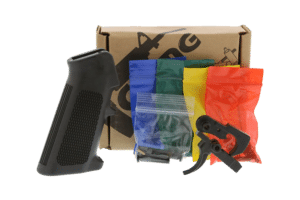
An AR-15 lower parts kit (LPK) is a package of the small components that turn a stripped lower receiver into a functioning one. A typical kit includes the fire control group (hammer, trigger, disconnector, and their springs and pins), the safety selector, magazine catch, bolt catch, pivot and takedown pins with their detents and springs, the trigger guard, and a pistol grip. Some kits also bundle a buffer retainer and spring; a smaller number add a stock and buffer assembly.
An LPK is the cheapest and most organized way to gather the parts needed to build or repair a lower. Quality matters: cheap castings and soft springs can drag, fail to lock up, or wear quickly, so a well-made kit is worth the modest premium, especially for a first-time builder.
Most kits ship with the small parts sorted into color-coded bags to keep the springs and detents straight during assembly.
The best AR-15 and AR-10 lower parts kits
CMMG AR-10 Lower Parts Kit
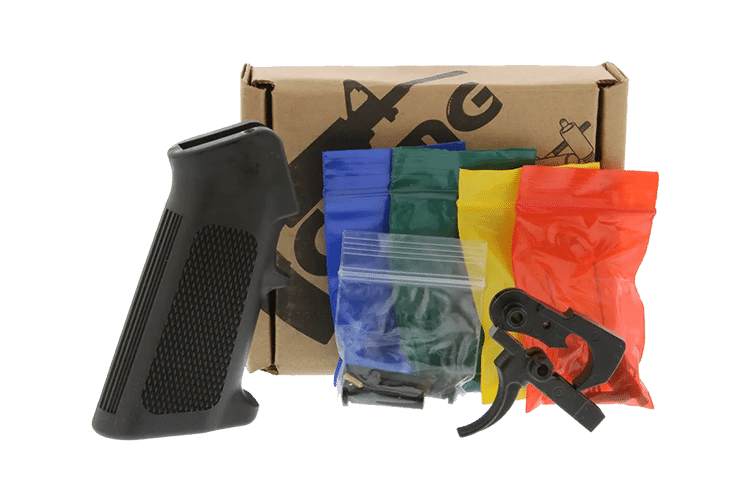
The CMMG AR-10 Lower Parts Kit is a complete mil-spec set: a molded-polymer A2 pistol grip, a single-stage trigger with a roughly 6 to 6.5 lb service pull, hammer, disconnector and their springs and pins, magazine catch and spring, bolt catch with plunger and roll pin, front pivot pin and rear takedown pin with detents and springs, safety selector with detent and spring, and a trigger guard. It is sized for large-frame AR-10/.308 lowers, so confirm the pattern of your receiver before ordering.
Brownells LPK

The Brownells LPK paired with a Geissele trigger is one of the more complete kits on the market. It includes a Geissele fire control group, a Magpul MOE stock and grip, and a buffer tube assembly that most LPKs leave out.
The parts arrive in separate color-coded bags, the trigger guard is metal rather than polymer, and the pivot and takedown pins use steel retainers instead of the brass detents found in cheaper kits. The price runs higher because the bundle includes the Geissele trigger, the MOE furniture, and the buffer assembly rather than bare small parts.
It is a strong pick for a builder who wants a near-complete package out of one box and values the upgraded trigger over squeezing out the lowest price.
Geissele Automatics Lower Parts Kit

The Geissele Automatics Lower Parts Kit is a no-frills, high-quality set. It includes everything needed to finish a lower except the trigger and pistol grip, leaving those choices to you. The parts are precision machined from quality steel, the safety is crisp, and the components are dimensioned to mil-spec so they fit a wide range of standard lowers. As with many kits, the magazine catch button may need light hand fitting.
Aero Precision Lower Parts Kit

The Aero Precision Lower Parts Kit is built for Aero's M4E1 and standard lowers and pairs a Magpul MOE grip and a billet trigger guard with the usual mil-spec small parts. The components are corrosion resistant and made in the USA.
The parts are compatible with standard AR-15 lowers and the kit comes sorted into color-coded bags. It is a clean, builder-friendly set that keeps the assembly headaches to a minimum.
PSA MOE Lower Build Kit

The PSA MOE Lower Build Kit bundles a Magpul MOE stock, grip, and trigger guard with a buffer tube, plus a standard single-stage government-style fire control group with polished contact surfaces and a nickel-coated hammer and trigger.
It builds a complete rifle or pistol lower to mil-spec dimensions, which makes it broadly compatible and a strong value for a reliable, no-surprises build.
SMLP K2 Mil-Spec Lower Parts Kit
The SMLP K2 Mil-Spec Lower Parts Kit covers the full small-parts list: A2 pistol grip, hammer, trigger, disconnector and their springs, safety selector with detent and spring, magazine catch with spring and button, bolt catch and spring, front pivot pin, rear takedown pin, and buffer retainer with spring. The pins and detents are nickel plated for a smoother feel and added corrosion resistance.
CMC Triggers AR-15 Lower Parts Kit
The CMC Triggers AR-15 Lower Parts Kit includes a molded A2 pistol grip, a trigger with spring, disconnector, hammer and spring, bolt catch with spring, plunger and roll pin, magazine catch with spring and button, safety selector with detent and spring, front pivot pin, rear takedown pin with detents and springs, buffer retainer and spring, and an enhanced aluminum trigger guard. CMC is best known for its drop-in trigger modules, and this kit pairs cleanly with one if you decide to upgrade later.
SOLGW Blaster Guts With Liberty Fighting Trigger
The Sons of Liberty Gun Works (SOLGW) Blaster Guts kit holds to mil-spec dimensions with steel magazine catch and button, bolt catch, and safety selector.
The Liberty Fighting Trigger is built for duty and defensive use, with a smooth single-stage pull that breaks in the 6 to 6.5 lb range. The kit pairs it with a B5 Systems pistol grip. It is a durable, function-first set with tight quality control rather than a competition-style match trigger.
What to consider when choosing an AR-15 lower parts kit
Quality and Fit
Quality and fit are the first things to weigh. A good kit uses properly hardened springs and detents and parts machined to spec so they drop in without binding. Check the finish on the metal parts for burrs or uneven coating, and do a quick fit check on each piece to confirm it moves freely inside the receiver.
After assembly, run a function check: the trigger should release the hammer cleanly, the safety should block and allow the trigger as expected, and a magazine should lock in and drop free without forcing. Get this right and the rest of the build comes together easily.
Price
Prices vary widely with brand and contents. Bare mil-spec small-parts kits sit at the low end. Mid-tier kits that add Magpul furniture or a buffer assembly cost more, and premium bundles built around a Geissele or other upgraded trigger run highest. Expect to pay a budget price for a basic kit, a moderate price for a furniture-included build kit, and a premium for a kit centered on an enhanced trigger.
Features and Options
Beyond the standard small parts, kits differ in their extras. Some include only the fire control group and pins; others add a pistol grip, trigger guard, stock, and buffer. Upgraded kits may swap the conventional trigger for an enhanced or drop-in unit, add a Magpul MOE grip and billet trigger guard, or use nickel-finished pins and contact surfaces for a smoother feel. Decide which of those you want bundled versus sourced separately.
Compatibility
The parts have to match your lower. Standard AR-15 small parts fit mil-spec lowers, but some receivers, including certain Aero, Seekins, and other proprietary designs, use a set screw or a slightly different bolt catch or takedown detent arrangement. Confirm whether your lower is standard mil-spec or a proprietary pattern before ordering.
AR-10/.308 lowers are a separate case entirely: several parts are not interchangeable with AR-15 components, and the AR-10 itself comes in more than one pattern, covered below.
Size and weight
The biggest size difference is platform: an AR-15 kit is smaller and lighter than an AR-10/.308 kit, whose larger receiver uses correspondingly larger pins and a bigger bolt catch. Within the AR-15 world the small parts weigh only a few ounces and the practical difference between kits comes down to whether furniture and a buffer assembly are included, not the parts themselves.
Finish
Finish affects both durability and feel. Look for even coatings free of burrs, with parts that mate cleanly. Phosphate is the standard mil-spec finish; nickel boron, nickel plating, and similar coatings reduce friction and add corrosion resistance, which is why they show up on enhanced fire control parts.
The trigger pull and reset depend on the specific parts in the kit. Basic kits give a conventional single-stage pull, while enhanced or drop-in triggers offer a lighter, cleaner break. Match the finish and trigger to how you intend to use the rifle.
Caliber options
An LPK is largely caliber-agnostic within its platform. The same AR-15 small parts work whether the rifle is chambered in 5.56 NATO, .223 Remington, .300 Blackout, or another AR-15-length cartridge, since the lower does not interact with the chamber. The AR-10 platform covers the larger .308 Winchester and 6.5 Creedmoor class of cartridges and uses its own, larger parts.
Trigger group and safety
The trigger group and safety are where kits differ most. A mil-spec kit uses a conventional single-stage trigger with a roughly 6 to 6.5 lb pull. Enhanced kits may include a drop-in trigger module, a lighter two-stage trigger, or polished and nickel-coated contact surfaces for a smoother break and reset.
On the safety side, some kits add an ambidextrous selector for left-handed or support-side use, and a short-throw selector that moves between safe and fire in a 45- or 60-degree arc instead of the standard 90. Pick the trigger and safety that fit how you shoot.
Stock and Buffer
Some kits go beyond the lower parts to include the stock and buffer system, turning a stripped lower into a fully assembled receiver in one purchase. A full build kit of this type typically adds a carbine or rifle buffer tube, buffer, and spring, a stock, and a pistol grip on top of the fire control group.
If you already have a stock and buffer assembly, a bare small-parts kit is the more economical choice. If you are starting from just a stripped lower, a build kit that includes the buffer system saves you sourcing those pieces separately.
Upper Receiver Build
A lower parts kit only completes the lower; it does not include upper-receiver components such as the barrel, bolt carrier group, charging handle, ejection port cover, or forward assist. Plan your upper separately and make sure the two halves share the same platform, since an AR-15 lower mates with an AR-15 upper and an AR-10 lower with a matching AR-10 upper of the same pattern.
For builders comparing options, the CMMG and Aero Precision kits are reliable mil-spec choices, while kits built around an enhanced trigger cost more but give a better break out of the box.
Build Options
Builders have room to mix and match. A kit like the CMC Triggers set lets you choose your own trigger, the Aero Precision kit comes with a Magpul MOE grip and billet trigger guard, and the Geissele kit leaves the trigger and grip open so you can specify them. KE Arms, Brownells, Double Star, and Luth-AR all offer kits ranging from basic mil-spec to enhanced.
As long as parts share the same specification, you can combine pieces from different kits to suit your budget and ergonomics. Decide what matters most, whether that is the trigger, the grip, included furniture, or simply price, and build around it.
Retailers
Several retailers stock complete and partial LPKs. Brownells carries its own kits as well as bundles with upgraded triggers, Palmetto State Armory offers the MOE Lower Build Kit, and CMMG, Aero Precision, and Geissele sell their kits directly. Seekins Precision and Elftmann Tactical round out the higher-end options. Buy from a reputable source so you know the parts meet spec and are backed by a warranty.
FAQ
What is a Lower Parts Kit (LPK) for an AR-15?
A Lower Parts Kit is the set of small parts needed to complete the lower receiver of an AR-15. It includes the components that make the lower function: pistol grip, trigger, trigger guard, hammer, disconnector, bolt catch, magazine catch and release button, safety selector, the pivot and takedown pins with their detents and springs, the trigger and hammer pins, the buffer retainer and spring, and the various fire-control and selector springs.
It does not include upper-receiver parts such as the ejection port cover or forward assist, which live on the upper half of the rifle.
Kits range from complete sets to ones that omit the trigger, grip, or trigger guard so the builder can choose those parts. A good LPK makes finishing a stripped lower considerably easier.
What is the best Lower Parts Kit (LPK) for an AR-15?
There is no single best kit; the right one depends on your build, but a few stand out.
The Aero Precision LPK is a strong all-around choice for quality parts that meet mil-spec, with an enhanced billet trigger guard. CMMG offers a reliable, complete kit with an upgraded fire control group, and Stag Arms makes a dependable kit that includes everything but the pistol grip and is backed by a warranty.
For an upgrade-focused build, a kit built around a Geissele or other enhanced trigger gives the best break. Weigh build quality, included parts, and warranty against your budget to pick the right one.
What is the difference between an AR-15 and an AR-10 Lower Parts Kit (LPK)?
The AR-10 is the larger-caliber parent of the AR-15. Eugene Stoner designed the AR-10 in the mid-1950s, and ArmaLite later scaled it down around the .223/5.56 cartridge to create the AR-15, so the AR-10 is the older and larger of the two platforms.
Because of that size difference, several parts do not interchange between the two. The bolt catch, pivot and takedown pins, buffer and buffer spring, and magazine catch are dimensioned for the larger AR-10 receiver, while the fire control small parts are often shared. Always buy the kit that matches your platform.
The AR-10 also comes in more than one lower pattern, most commonly the DPMS (LR-308) and the Armalite/SR-25 patterns, which are not cross-compatible. Confirm which pattern your lower follows before ordering.
What is the difference between a mil-spec and a precision Lower Parts Kit (LPK)?
The difference comes down to quality of materials, finish, and trigger feel.
Mil-spec kits are built to military dimensions and offer dependable, no-frills function at a lower price. Precision or enhanced kits cost more and add upgrades such as polished or nickel-coated contact surfaces, tighter machining, and often a lighter or two-stage trigger.
Some proprietary lowers, including certain Aero receivers, require a set screw to take up tolerance, which enhanced kits may include. In short, precision kits trade higher cost for a better feel and finish, while mil-spec kits deliver proven reliability for less.
What brands make the best Lower Parts Kit (LPK) for an AR-15?
Several brands have strong reputations for LPKs.
Aero Precision offers a complete kit, minus the pistol grip on some versions, built to mil-spec with an enhanced billet trigger guard. Stag Arms includes everything for the lower and backs it with a warranty. CMMG is known for attention to detail and complete, reliable kits, and Luth-AR offers a broad line focused on quality components. Geissele, ALG Defense, CMC Triggers, and Anderson are other well-regarded names spanning the budget-to-premium range.
Whichever you choose, favor quality materials and a reputable maker so the lower runs smoothly and reliably.
What are the pros and cons of the different Lower Parts Kit (LPK) options?
Each style of kit has trade-offs.
A complete kit like CMMG's installs easily, ships in color-coded bags, and includes the grip and a few spare parts, but it does not include a stock, and some users find the bolt catch pin a tight fit. A standard mil-spec kit such as Aero Precision's is broadly compatible and straightforward to install, though it likewise leaves out the stock and buffer.
A bare small-parts kit costs the least but assumes you supply the grip, trigger, or furniture, while a full build kit costs more but turns a stripped lower into a finished receiver in one box. Pick the kit that matches what you already have and what you are willing to assemble.
How do I know which Lower Parts Kit (LPK) is compatible with my AR-15?
Matching an LPK to your lower is straightforward if you work through a few steps:
- Know your parts. Familiarize yourself with the components that make up an AR-15 lower: pistol grip, trigger guard, trigger, hammer, disconnector, bolt catch, magazine catch and release button, safety selector, the pivot, takedown, trigger, and hammer pins, the buffer retainer and spring, and the selector, bolt catch, and disconnector springs.
- Consider your starting point. Building from a bare lower calls for a complete kit. If you already have a stock and pistol grip, a kit that omits those, such as the Geissele set, will do.
- Research and compare. Once you know what you need, compare kits on quality and price to get the best value.
- Mix and match. You can combine parts from different kits as long as they share the same specification and are made for your platform.
For an upgrade path, a drop-in module like the Geissele SSA-E offers a smooth two-stage pull and fits standard mil-spec lowers, making it an easy way to improve a build later.
What is the difference between an LPK and a build kit?
An LPK converts a stripped lower receiver into a functioning one. It contains the small parts for the lower: pistol grip, trigger, trigger guard, magazine catch, safety selector, and the pins and springs.
A build kit is broader. Depending on the seller it may add the stock and buffer system to a lower build, or, in the case of a full rifle kit, include everything needed to complete the rifle around a lower receiver, from the barrel and upper to the furniture.
In short, an LPK finishes the lower, while a build kit bundles additional components toward a more complete rifle.
How do I properly install a Lower Parts Kit (LPK) for an AR-15?
Installing an LPK takes patience and a little care with the small springs and detents, but it is well within reach for a first-time builder. Lay out and identify all the parts first, then work through the assembly in order:
- Install the magazine catch and spring, and fit the bolt catch with its spring, plunger, and roll pin.
- Drop in the trigger and disconnector with their springs, then the hammer, securing them with the trigger and hammer pins.
- Install the safety selector, then the selector detent and spring, and screw on the pistol grip, which captures that spring.
- Install the trigger guard.
- Fit the front pivot pin and rear takedown pin with their detents and springs.
- Install the buffer retainer and spring, holding them down as you thread on the buffer tube.
When everything is in, run a function check: confirm the hammer cocks and releases, the safety blocks the trigger on safe, and the parts move freely. Inspect for wear or damage, then mate your upper receiver to the finished lower.
Once your gun is squared away, grab a suppressor and a suppressor cover and enjoy some range time.

Comments