
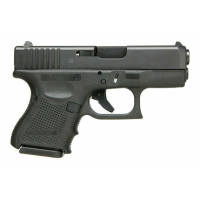
Maryland filed its defense last week in Bathras v. Moore, the federal Second Amendment lawsuit challenging the state's new law banning the manufacture, sale, purchase, and transfer of what the legislature classified as "machine gun convertible pistols." AmmoLand News reported on the state's response on July 13. Maryland's position is that the cruciform trigger bar integral to every standard Glock model constitutes a design feature that makes the pistol susceptible to conversion by an illegally installed auto sear — placing stock, factory-standard Glock handguns within the law's prohibition.
Maryland Senate Bill 334 was signed by Gov. Wes Moore on May 26, 2026, and is scheduled to take effect January 1, 2027. The NRA, the Firearms Policy Coalition, and the Second Amendment Foundation filed suit the same day Moore signed the bill. A June 25 amended complaint added three named plaintiffs: David J. Bathras Sr., a Maryland resident who owns a Glock and wants to purchase additional models and retain the right to sell or transfer his existing pistol through lawful channels; Roslyn Mickens, a registered gun collector and licensed firearms instructor who intends to acquire Glock-pattern handguns; and Atlantic Guns, a Rockville dealer. The case is proceeding in federal district court.
The central question the plaintiffs have put to the court is whether a state can ban a factory-standard, unmodified, commonly-owned handgun on the basis of what a criminal could attach to it after the fact. Bearing Arms covered Maryland's response on July 13, noting the argument carries implications beyond Glock specifically: if the state's logic holds, any widely-owned semi-automatic pistol with a design feature that third-party contraband could exploit would potentially be subject to the same treatment. Glock-style pistols represent a significant share of the handguns carried daily by lawful gun owners in the United States, and Glock models are issued as standard duty weapons by police departments across the country — meaning Maryland's law would, if upheld, prohibit residents from owning the same pistols their own law enforcement officers carry.
The law does not take effect until January 1, 2027, and the case is still in early proceedings. The plaintiffs are expected to seek a preliminary injunction to block enforcement before the effective date, which would put a stay decision before the court later this year. The NRA, FPC, and SAF are each independently monitoring similar state-level legislation in other jurisdictions that has been modeled on Maryland's approach, and the outcome of Bathras v. Moore is likely to influence those parallel efforts.

Comments