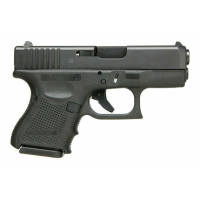
Connecticut Governor Ned Lamont signed HB5043 into law last Wednesday, making Connecticut the third state in 2026 to ban so-called convertible pistols — a category written broadly enough to cover Glocks and most other popular striker-fired handguns. The National Shooting Sports Foundation, headquartered in Newtown, Connecticut, announced it will challenge the law in court, calling it an unconstitutional infringement on the rights of law-abiding gun owners who bear no responsibility for criminals using illegal conversion devices.
The new law, designated Public Act 26-41, makes it a Class D felony to sell, import, distribute, or advertise a convertible pistol in Connecticut after October 1, 2026, with penalties up to five years in prison. The law defines a convertible pistol as any semiautomatic pistol with a cruciform trigger bar that can be readily converted into a machine gun by hand or with a common household tool using a pistol converter — a reference to the illegal Glock switch devices that law enforcement has recovered from crime scenes. Connecticut joins Maryland, where Governor Moore signed a nearly identical ban in May and faced immediate federal lawsuits from the NRA, SAF, and FPC the same day, and New York, which added the restriction through its 2026 budget process.
NSSF Senior Vice President and General Counsel Lawrence Keene issued a pointed statement distributed through The Outdoor Wire. Bearing Arms reported Thursday that NSSF was still assembling potential plaintiffs and had not yet filed a formal complaint. Keene's statement argued the law "punishes law-abiding citizens by infringing on their Second Amendment rights to legally obtain the firearms they choose to protect themselves and their families against criminals who, by definition, have no respect for life or law." The foundation's position is that the remedy for illegal switch use is criminal prosecution of those who possess and use them — not a prohibition on the most common defensive handgun platform in the country.
The legal terrain for these bans is increasingly contested. Courts applying the Bruen text-and-history standard have shown skepticism toward restrictions on commonly owned defensive arms. Connecticut falls in the Second Circuit, which in May struck down New York's vampire rule on private carry — a ruling that signals the court will apply Bruen rigorously to novel handgun restrictions. An NSSF challenge in Connecticut would join the parallel federal suits already pending over Maryland's and New York's similar measures.
With the October 1 effective date still four months out, there is room to file, brief a preliminary injunction motion, and seek a hearing before the ban takes effect. The NSSF-funded Black v. Hook challenge to Virginia's assault firearms ban, which is seeking a June 19 hearing ahead of that state's July 1 effective date, offers a model for how quickly the foundation can move on injunctive relief when time matters.


Comments