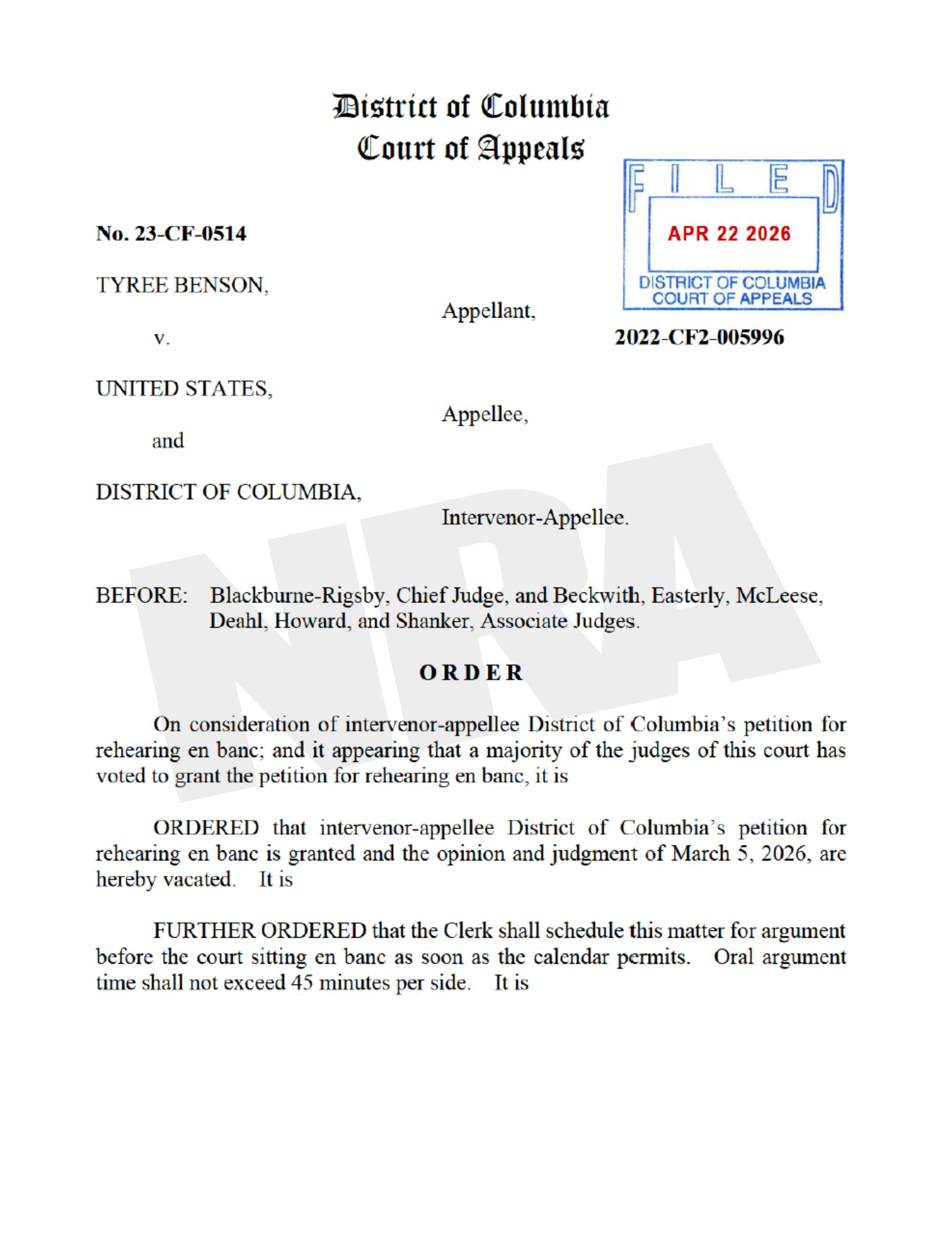
The District of Columbia Court of Appeals vacated a panel ruling that had struck down the city's 10-round magazine limit, granting en banc rehearing in Benson v. United States on April 22, Bearing Arms reported Thursday. The order erases a March 5 decision in which a three-judge panel ruled 2-1 that the District's ban on magazines capable of holding more than 10 rounds violated the Second Amendment — a significant appellate win for gun rights advocates that will now have to be re-litigated before the full court.
The underlying case began with Tyree Benson, who was arrested and convicted for possessing a firearm with a 30-round magazine in violation of D.C.'s longstanding magazine restriction. Benson challenged the conviction on Second Amendment grounds, and the three-judge panel agreed, striking down the 10-round limit and sending the case into the national spotlight.
The case then took an unusual turn at the federal level. D.C. U.S. Attorney Jeanine Pirro informed the court that her office is "no longer defending the constitutionality" of the magazine statute and moved to vacate Benson's conviction on that count, according to AmmoLand News. Even so, Pirro urged the full court to take up the case, expressing concern that the panel's broad Second Amendment reasoning could threaten D.C.'s gun licensing and registration requirements — a separate set of restrictions the federal government was not willing to abandon. The Volokh Conspiracy at Reason flagged the DOJ's conflicted posture weeks before the en banc order came down.
The en banc order directs the parties to brief two distinct questions: whether the District's ammunition magazine restrictions violate the Second Amendment, and whether D.C.'s gun licensing and registration framework itself survives constitutional challenge. The second question — folded in by the court and supported by amicus parties — widens the case's potential scope well beyond the magazine limit that gave it its name. Chief Judge Anna Blackburne-Rigsby and six associate judges, Beckwith, Easterly, McLeese, Deahl, Howard, and Shanker, will hear the rehearing.
For lawful gun owners watching the case, the short-term picture is unfavorable: the panel victory is gone, and a full court that includes the original dissenter is now in charge. The upside is that a favorable full-court ruling on both questions could produce binding D.C. precedent covering not only magazine capacity limits but the District's broader registration scheme.
Under the court's schedule, Benson's opening brief is due within 30 days of the April 22 order, appellees' briefs 30 days after that, and any reply 21 days following. Amicus briefs must be filed within seven days of the brief of the party each amicus supports. Second Amendment groups including the Firearms Policy Coalition and Second Amendment Foundation are expected to participate. An oral argument date has not yet been announced.
Comments